What we do.
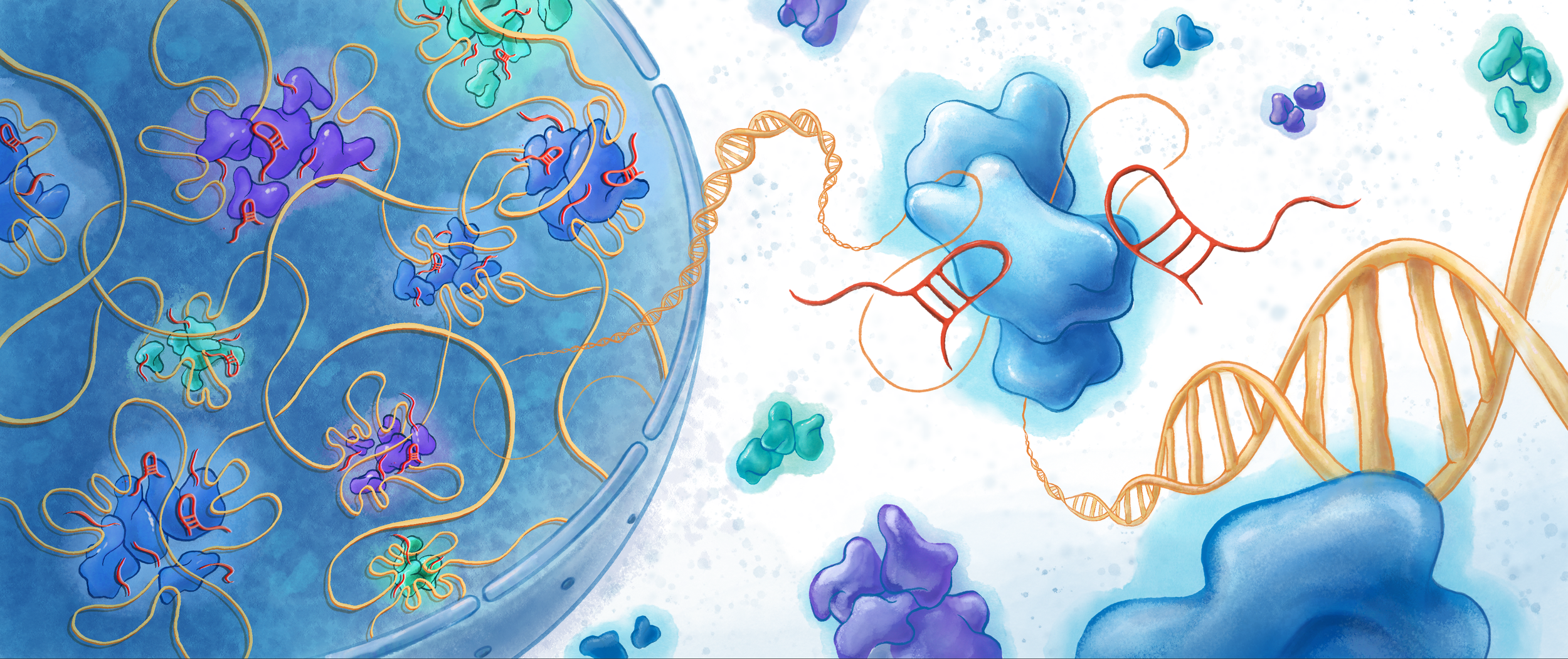
How are molecules arranged inside of the cell?
Inside every human cell, six feet of DNA and thousands of RNAs and proteins are packed into a tiny nucleus. How can cells execute various complex reactions like gene regulation, RNA splicing, and ribosome assembly inside this crowded molecular environment?
Importantly, these molecules are not organized as a random tangle. DNA, RNA, and proteins can organize in specialized compartments called nuclear bodies, or biomolecular condensates. Condensates are dynamic—changing in size and number across cell states and in diseases like cancer and neurodegeneration.
Yet, despite being discovered over 200 years ago, their roles remain mysterious. Do nuclear bodies simply store factors or actively accelerate critical cellular reactions? Does their dysregulation lead to disease?
These questions have persisted because we lacked tools to measure and dissect the structure and function of condensates.
We build cutting-edge tools to tackle these questions.
We combine genomics, RNA biology, and super-resolution microscopy to uncover how nuclear bodies and other condensates organize molecules in the cell to orchestrate RNA processing, gene regulation, and more.
Our goal is to reveal principles underlying nuclear organization, cellular compartmentalization, and RNA metabolism—and how their disruption contributes to various diseases.
How?
Under the microscope.
We use advanced microscopy approaches to visualize where and how molecules arrange inside various compartments (e.g., nucleoli) in the cell.